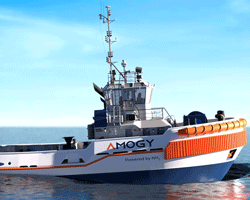
New York-based start-up Amogy plans to unveil a zero-emission tugboat later this year, utilising ammonia as its alt-fuel of choice. Rather than opting for a newbuild, the demonstration tug will be a 1957-built model, retrofitted with a 1MW version of Amogy’s ammonia-to-power system. The tug will undertake its initial voyage on an inland waterway in upstate New York, and will be Amogy’s first proper venture into the marine sector, following a series of land-based retrofits.
In July 2021, the company integrated its ammonia-to-power solution into a 5kW aerial drone, before scaling up the system to power a 100kW John Deere tractor in May 2022. In January 2023, Amogy demonstrated the use of its ammonia on a retrofitted 2018 Freightliner Cascadia semi-truck, for which the system was boosted to 300kW. In comparison, the 1MW tug installation will represent just over three times the power kick of the semi-truck and five times that of the tractor.
Founded in 2020 by four alumni from Massachusetts Institute of Technology, Amogy has raised US$70 million in funding, attracting blue chip investors such as Amazon and Saudi Aramco. For the forthcoming tug demo, the company is working alongside C-Job Naval Architects, tasked with supervising the retrofit and integration of the ammonia system, and Feeney Shipyard, New York, which will physically convert the vessel. Unique Technical Solutions, Amogy’s electrical and systems integrator from its previous three demos, has also been brought on board.
Why pick ammonia over methanol, hydrogen or biofuels? Amogy tells Ship & Boat International: “There are two main problems when it comes to using hydrogen as a fuel: energy density and the cost of storage. Typically, hydrogen has to be stored in liquid form at very high pressures and low temperatures, which can be challenging and not very cost-efficient. Ammonia is not only more energy-dense than hydrogen, but is also cheaper and easier to store in a liquid form at room temperature. Ammonia also has a higher energy density than lithium-ion batteries, and this can make a difference where cargo space is at a premium.”
Ammonia has not been widely adopted by the maritime sector, yet around 200 million tonnes of the substance is transported globally each year, most commonly used as fertiliser by agriculture. “Unlike some alternative fuels, the infrastructure to ship and store ammonia is already widely in place,” Amogy continues.
The demonstrator tug measures 32m x 8.23m, with a depth of 4.57m. With its diesel engine removed, the vessel will be refitted with Amogy’s ammonia-to-power system, designed to enable onboard cracking of ammonia into hydrogen. The resultant hydrogen is then sent directly to a fuel cell, which powers the tug’s electric motors without any carbon emissions. “Ammonia does not contain any carbon molecules and, thus, our system releases zero carbon emissions at the point of use,” Amogy adds. The tug will source its green ammonia from Yara Clean Ammonia (YCA), which is planning the launch of a global ammonia bunker network from Scandinavia. Amogy says: “Logistics are still being worked out, but we will likely bunker the ammonia to the tugboat from a truck nearby: Yara has ammonia production facilities in North America."
At the time of writing, Amogy was yet to confirm a date for the end-of-year New York demonstration. The company stresses, though, that crew safety is of paramount importance. “Ammonia is toxic…it is necessary for protocols and practices to be put in place so we can safely transport it,” says Amogy. “We’re putting safety first and will only conduct a trial when we’re satisfied that the system is reliable and meets all the required safety regulations.” To this end, the New York sailing will be supervised by the US Coast Guard and class society DNV.
After this year’s demo, Amogy plans to make the ammonia-fuelled tugboat a commercial reality in 2024. Beyond this particular project, the company wants to play a wider role in helping the shipping industry to meet its looming Net Zero 2050 goals. “International shipping accounts for about 3% of global energy-related CO2 emissions – a percentage that’s expected to climb as more vessels deliver more goods,” the group says. “By introducing a clean energy source for heavy industries, our technology will enable these industries to decarbonise their downstream operations.
"On the upstream side, there are many companies that are working on decarbonising ammonia production. While Amogy’s technology can be used with all types of ammonia, we’re partnering with green ammonia producers and see the usage of ‘blue’ or ‘green’ ammonia as a way to enable well-to-wheel decarbonisation for our target industries.”