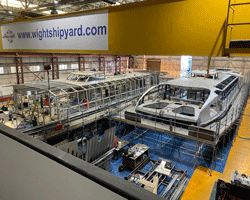
You might believe from press reports that ferries are leapfrogging hybrid power and going straight to all-electric running, supported by ready-to-install power solutions, writes Stevie Knight. However, James Mozden, principal naval architect at Wight Shipyard Co. (WSC), tells Ship & Boat International that implementing a low-emission solution can be complex – and that, despite the availability of all-in-one electric drive trains: “Off-the-shelf solutions won’t necessarily work where there are very specific demands on the route or vessel”.
Take the new Uber Boat by Thames Clippers. The ferry company serves 24 piers on a 25km stretch across London. There’s a 10-20 minute frequency between key London piers, and popularity is rising: estimates put passenger numbers at 4.9 million in 2022.
New boats are definitely needed. Consequently, WSC and naval architecture firm One2Three have collaborated with the operator on its Hunt-class design. These 36m catamarans combine slender hulls with a shallow draught and low wave resistance to meet the challenges of limited depth and restricted bridge height – as well as keeping the wash down around London’s historic river architecture. However, Mozden says: “Compared to standard diesel, all the available alternatives have a lower energy density, and storage of that energy is heavier and requires more space. Recharging also takes far longer, and you need to have charging points available.”
Further investigation showed that a fully electric vessel “couldn’t meet the route schedule and berthing times as it only stops for a few minutes: you just can’t get enough into the batteries to support the duty cycle”, Mozden says. A biofuel hybrid was settled on as the only current realistic option...but even that came with its own issues, as there’s a pretty hefty weight penalty on a hybrid drive train.
The new catamaran uses IMO Tier III-compliant MAN D2682 engines in both hulls, scaled to propel the ferry up to 28knots: enough of a margin to deal with tidal flow and extra loads. Each engine is paired with a two-into-one reversing gearbox connected to the shafts of the Kongsberg S45 waterjets. While scaling the engines was fairly simple, sizing the energy storage was tricky: the 475kWh Spear Li-ion energy storage – which works as a single unit, despite being divided between each hull for balance – should be capable of retaining an 80% charge after an eight-year lifespan, though the operator hopes to achieve more.
Although the batteries begin the morning fully charged courtesy of an overnight hook-up, the all-electric, 12knot transits through the ‘zero-zone’ stretch of London would drain them significantly, undermining the cycle life. To compensate, the batteries benefit from a regular top-up while the diesels are running. However, to reduce NOx and SOx emissions on the longer legs of the route, the engines employ SCR scrubbers.
All together, this system came in at around 12.5tonnes – about 3.5 tonnes over a more standard powertrain. To mitigate, all areas within the vessel were assessed to see where the kilos could be trimmed. For example, the auxiliary gensets were removed and the light hotel loads routed to the battery instead. The structure itself was also reviewed for weight-saving measures: even the welds were scrutinised. “As a rule of thumb, welding adds about 3% in mass,” Mozden reveals. Consequently, non-load bearing panels were riveted.
However, there was still a significant impact on displacement and therefore wash – minimising this is a key demand for operating on the Thames. The solution had to be a revision of the 36m hull, but Mozden underlines there was a limit to how much could be altered while retaining the outline of the previous Uber Boat vessels.
(For the full in-depth article, check out Ship & Boat International January/February 2023)