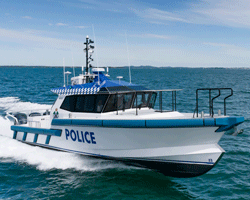
The Queensland Police Service (QPS) in Australia is bolstering its waterborne activities with the first in a series of seaworthy and customisable patrol vessels. Designed and built domestically by Norman R. Wright & Sons, the new 12m XLW patrol boat class has been developed to operate away from shore for extended periods, across a wide window of weather conditions and sea states, both in Queensland’s waters and in remote, offshore and tropical locations.
“This new class of vessel is designed from the ground up specifically for extreme patrol boat use, without compromise,” Adam Evripidou, director and head naval architect at Norman R. Wright & Sons, tells Ship & Boat International. The 12m XLW hullform is based on that of the company’s existing 14.2m XLW pilot boat class. He explains: “The 12m limit is driven by Australian Maritime Safety Authority [AMSA] requirements for the vessel’s crewing capabilities…an AMSA Grade 3 class coxswain can operate a vessel in National Standard for Commercial Vessels [NSCV] survey up to 12m in length.”
Additionally, the 12m XLW’s structure has been approved by DNV for patrol boat applications. “The longer waterline has been proven by our larger 14m XLW class, and was also verified with CFD before we signed off on the hull,” Evripidou continues. “The longer waterline offers a hull bottom that would normally be used to carry the deck of a 14m vessel, which allows this vessel to outperform other 12m patrol boats.”
The first-in-class 12m XLW was built with a foam-cored epoxy glass sandwich structure. “Vessels built from aluminium with the same structural strength are anywhere from 1-2tonnes heavier,” says Evripidou. Removing the risk of aluminium corrosion should help the QPS to avoid inconvenient maintenance-/repair-related downtime. The 12m XLW borrows the design of its safety rail system from its pilot boat ‘big brother’, and this provides the crew with a full 360° travel around the vessel. “With the wide side decks and safety rail, we provide intercept zones high up forward, mid-height at midships and in a lower zone when in the cockpit when intercepting smaller vessels,” Evripidou says. Personnel can board the 12m XLW over the bow, and the boat’s single swim ladder can be used at the side gate, and also off the foredeck, for speedy beach access.
Evripidou highlights another benefit of the 12m XLW’s cored-composite monocoque construction: a lack of internal hull stiffeners, combined with reduced framing. “All visible accommodation framing is structural, with uninterrupted storage behind these structural panels,” he says. “These storage lockers offer unimpeded hull inspections, as there is no flotation foam, which can hinder hull surveys, anywhere in the vessel.” All the same, to meet AMSA’s ‘one compartment flooding’ standard, the 12m XLW incorporates inbuilt buoyancy chambers inside the boat’s transom pod.
The area beneath the cabin provides storage space for up to eight Pelican 1560 Protector hard cases, which would typically contain police equipment. Another space, located under the cockpit deck and accessible via aluminium watertight hatches, provides room for a swim ladder and ropes, plus fire and salvage hoses.
The debutante 12m XLW is powered by three Yamaha F425 XTO outboards, delivering a cruise speed of 30knots at 161litres per hour, and top speeds in excess of 50knots at 421litres per hour. The boat has a range of 265nm at 30knots with 10% reserve. However, Evripidou says, the model could be tweaked to offer a range of up to 350nm, depending on how it is configured, and could alternatively incorporate a powertrain comprising twin outboards and Volvo IPS inboard diesel power.