David began his presentation by saying that, five years ago, he had made a presentation to RINA and IMarEST on a similar topic, that keels fall off yachts all the time, and this is bad news. Then everyone agreed! He summarised his previous presentation by saying “I’ll get back to you”. He has not yet reached any conclusions, but this presentation presents the state of play and his thoughts about the way forward.
He was also pleased to see the classification societies represented in the audience, especially DNV GL, as they are mentioned nicely in the presentation! He would also like to be able to present to the classification societies in three years’ time with some draft rules to prevent ballast keels falling off yachts. A recent example of this was two 12 m Route du Rhumb yachts both losing their keels on the same night, and both had been checked and found to comply with the European Union’s Recreational Class A Directive! [The Route du Rhumb is a trans-Atlantic single-handed yacht race, which takes place every four years in November between Saint Malo, France, and Pointe-à-Pitre, Guadeloupe — Ed.]
The Problem Space
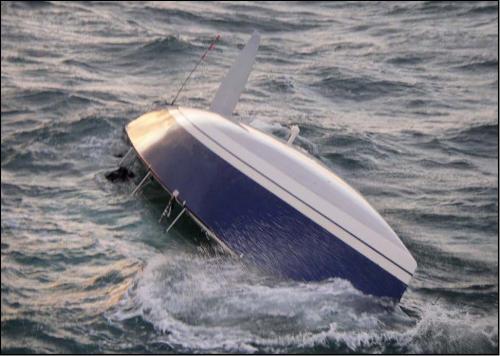
Here David showed a slide of the Max fun 35 yacht Hooligan V upside down after losing her keel while on passage from Plymouth to Southampton on 2 February 2007. This happens; it is tragic, as it usually involves loss of life. It is not just composite vessels which lose their keels, aluminium ones do too, and two-thirds of the cases are due to inadequacies in the bilge–keel attachment area. We now have enough recovered evidence to help with backwards analysis of the cases.
He is proposing a three-pronged approach:
Physical testing of specimens. These should not be tiny (which may not scale well), but full-sized specimens with full keel bolted construction and strain gauged in the layup.
Numerical analysis. This should be a finite-element analysis, with realistic assumptions about the material properties.
Instrumented on-water sailing. This is to measure the loads experienced by the full-scale vessel on the water.
Hooligan V after loss of keel
(Photo from Marine Accident Investigation Branch Report 19/2007)
The Problem with Today’s Marine Codes
Existing marine design codes do not provide guidance for the designer to check through-thickness inter-laminar stress in a vessel’s composite structure when loaded—this is simply missing. The codes concentrate on in-plane adequacy of the laminate. It is assumed that the load-carrying fibres and resin matrix perform in an integrated way, addressing in-plane stresses as a result of bending in response to a lateral load.
Tensile and compressive fibre fractures are considered; tensile, compressive and shear inter-fibre fractures are considered partially or not at all. This leaves the designer guessing at what is required for true adequacy. Out-of-plane loads are not well catered for, and this arouses suspicion, especially when it results in broken boats.
The Problem Statement
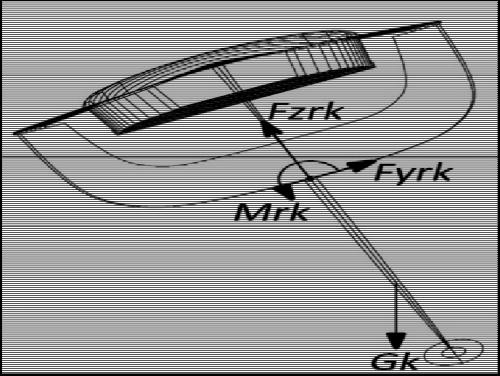
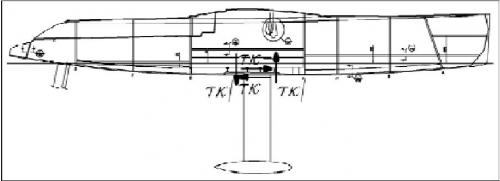
David then showed some slides of the forces involved in a static representation of what is, in fact, a dynamic situation, of the forces and moments imposed on the hull by a ballast keel when sailing at sea. There is a concentrated load on the yacht’s hull at the bilge–keel join due to the cantilever and torsional moments imposed by the keel. Many people will have seen videos of yachts falling off waves while taking part in the Sydney–Hobart Yacht Race.
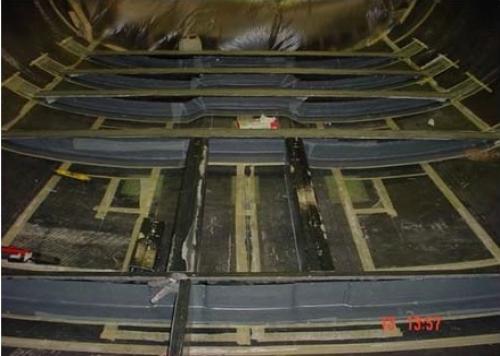
Transmitting the forces and moments to the hull requires a system of four or five transverse floors in way of the keel.
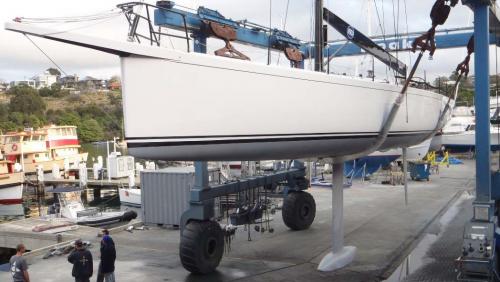
Ballast keel on Vanguard 60
(Photo courtesy David Lyons)
Transverse forces and moments imposed on the hull by the ballast keel
(Diagram courtesy David Lyons)
Longitudinal forces and moments imposed on the hull by the ballast keel
(Diagram courtesy David Lyons)
Keel flange and bolt arrangement on the Vanguard 60
(Photo courtesy David Lyons)
Internal floor arrangement on the Vanguard 60
(Photo courtesy David Lyons)
For the ballast keel of the Vanguard 60, the flange is 65 mm thick in 500 MPa cast iron, secured to treh hull by 16 studs. The bulb has a mass of 4 t, and the loads are transmitte4d to the composite fibre structure in the hull.
In the European Union, ISO 12215 is the default standard in order to obtain the CE mark for a Category A recreational vessel. Classification society rules may be used as an alternative. Despite having rules in place, and vessels complying with the rules, failures are still occurring.
Aims of the Research
The aims of the research are to
Identify the current understanding and treatment of inter-laminar stresses in composite design with reference to general underpinning theory, testing and analysis.
Uncover current practical approaches to dealing with inter-laminar shear in non-marine design, construction and inspection practice and assess their applicability in the composite marine context.
Design a methodology whose ultimate aim is to arrive at a set of composite marine design codes which address inter-laminar strength adequacy in both the intact and damaged conditions.
Bridge the gap between broad theory and targeted marine design.
Earlier work in this area has been done by Jun Ikeda in his BE thesis Analysis of the Keel Structures of Composite Yachts and Raju in his PhD thesis Failure Analysis of Composite Top-hat Stiffeners using Acoustic Emission and Embedded Fibre Bragg Gratings at UNSW.
Failure of Curved Composite Structures
The world of boat structure comprises various components in curved formats—plates, I-beams, radiused top-hat sections, and the like. Failures of the structures can have fatal consequences, and here David quoted some examples: Rising Farrstar in 2001 with one dead, Moquini in 2005 with six dead, Bavaria Match 42 in 2005 with one dead, and Cheeky Rafiki in 2014 with four dead.
In is a global problem, illustrated by locations on a map of the world—east coast of the USA, west coast of Mexico, east coast of South Africa, the Mediterranean, and the Tasman Sea.
Existing Composite Marine Design Codes
Codes which cover marine composite construction include
DNV GL Rules for Classification: Yachts, Part I Ship Technology, Section 3 Special Craft—Guidelines for the Structural Design of Racing Yachts.
Lloyd’s Register, Rules and Regulations for the Classification of Special Service Craft.
American Bureau of Shipping, Guide for Building and Classing Yachts.
International Standard ISO 12215-5: Small craft—Hull Construction and Scantlings, Part 5 Design Pressures for Monohulls, Design Stresses, Scantlings Determination.
DNV GL is currently the most active in this area, with their rules having come mainly from the3 partnership with Germanischer Lloyd. However, ABS deserves accolades for their pioneering work as well, introducing their Guide for Building and Classing Offshore Racing Yachts in 1986, which has become the basis for other rules too.
Consider some of the statements in the DNV GL rules:
“the evaluation of stresses/strains is focussing on the spot where the maximum through-thickness shear stress/strain occurs”
“with solid coreless laminates, the through-thickness inter-laminar stress is rarely a design criterion”
“beams should be designed in a way that the transfer of loads is fibre-dominant”
“in general it is preferred to have a fibre-dominant load absorption in a composite structure, but in some cases it will be unavoidable that through-thickness effects occur”.
“matrix dominant behaviour is not preferred … through-thickness loading (especially shear and tension) cannot always be avoided and yet needs to be handled in an appropriately conservative way … delamination caused by overloading, impact or deficient structural design is considered to be the cause for subsequent failure of components and thus can be deemed as the cause for fatigue with composites”.
The designer is left with no means of identifying the critical through-thickness load points in either the intact or damaged condition where through-thickness strength can be reduced by up to the order of 90%, and what to do about it.
David has spoken to all the expert practitioners in composite yacht design, including Gurit, Composites Consulting Group, High Modulus, Reichel-Pugh, and others, about out-of-plane loading, and they all say yes, it’s a worry, and cater for it by over design.
Other Composite Design Codes
There are composite design codes in fields other than marine.
British Standard BS EN13121-3:2008 (+A1:2010) GRP Tanks and Vessels for Use Above Ground—Part 3: Design and Workmanship.
Creemers, R.J.C. produced a Technical Report, Inter-laminar Shear Strength Criteria for Composites: An Assessment by Means of Statistical Analysis, which was specifically for thick laminates subject to through-thickness (transverse) loads in aircraft landing gear.
This leads us to wonder if the same sorts of failures are happening in other fields, and they don’t seem to be, outside of the marine area. So, we may not have to re-invent the wheel, but take some note of what is being done in other fields.
Food for Thought
More than thirty years ago, Kitching et al. tested very thick laminates and found inter-laminar tensile strength values of the order of only 10% of in-plane strengths. As soon as the loads on the marine structural laminate are ‘thrown’ from the fibre-dominant direction to the matrix-dependent through-thickness direction, such consideration becomes critical!
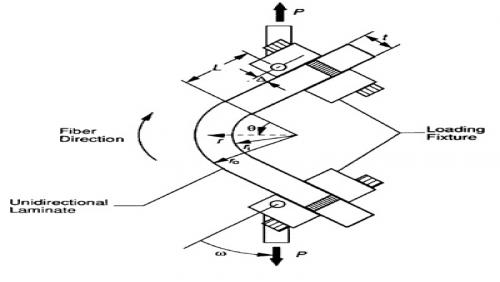
Imagine an L-shaped laminate under a tensile loading at 45o to the arms of the L, pulling the arms apart. The load results in an inter-laminar stress at the bend, pulling the laminates apart. In this case, you would be likely to hear an acoustic emission (noise) as the laminates come apart—something like the noise you would hear when crawling far out along a tree branch and the branch starts to fail at the trunk of the tree!
Inter-laminar tensile strength
(Diagram from Jackson and Martin)
The stresses which occur in the radial direction at the laminate bend are through-thickness (tensile) and the geometry of the ILTS specimen mimics the bend at the base of a stiffener such as a keel floor found in way of the attachment of a sailing yacht’s ballast keel.
Furthermore, a damaged keel attachment structure will have impaired through-thickness strength of less than about 50% of the undamaged strength. Existing marine codes make no allowance for this either, other than with a broad factor-of-safety.
Laboratory Tests
Raju’s work considered isolated 100 mm sections of top-hat stiffeners using laminates provided by David [thenat EMP Composites — Ed.] He suggested that a failure analysis of top-hat stiffened panels be conducted in the region where the whole keel is attached. These should use the same laminates as the on-water test vessels
A test matrix is being developed which systematically varies laminates, and tests for response to bending, as suggested by Raju for further work. Failure detection methods, including acoustic emission and embedded strain gauges, will be used.
Open-water Testing
A full-size laboratory boat has been built for the Milan Polytechnic in Italy for sailing yacht aerodynamic investigations and measurement of rig loads. However, load sensors can be placed in the bilge areas to obtain other information at the same time.
In addition, David has access to the Lyons 60 yacht Triton for full-scale tests.
Milan Polytechnic’s laboratory boat
(Image from Milan Polytechnic brochure)
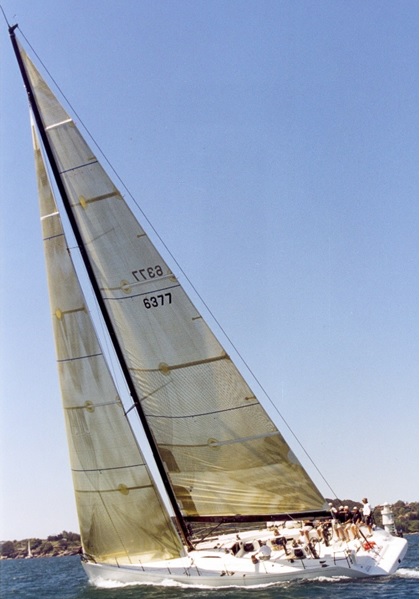
Lyons 60 Triton powering to windward
(Photo courtesy David Lyons)
SHM and NDE
Two terms that are commonly used in the area are SHM and NDE.
SHM is structural health monitoring whereby, with fibre optics and smart structures, you can get a feel for how the structure is faring during in-service operations, i.e. real-time information under load.
NDE is non-destructive examination, which can determine whether there is a problem in a structure before failure occurs. Marine surveyors of composite structures often say that they didn’t check something because they couldn’t see it. This is only partly true! They can use ultrasonics, thermographics and shearography, but it will cost some more to do. Do you want to know, or do you want to hope, because you can’t see it?
Here David showed a slide with an ultrasonic image of a keel floor damaged after grounding, and a laser shearograph of hull damage in way of the keel after grounding, and the damage was clear in both cases.
Conclusion
The aim is to research the background to, and provide evidence for, the development of marine design codes which address the through-thickness inter-laminar strength of composite laminates. The work is justified by structural failures causing loss of life on repeated occasions over the last few decades. A literature review including a search for design codes in related fields of application has been outlined and this review will continue throughout most of this work. A newly-developed marine code would address through-thickness strength requirements dealing with loads in the intact and damaged states, such as those experienced by sailing yachts subject to highly-concentrated ballast-keel loadings.
Questions
Question time was lengthy and elicited some further interesting points.
If we extend the case histories back some time, then problems are currently about equal for yachts constructed of composites and aluminium at the moment. However, no-one is building aluminium yachts any more, only composites, so the pendulum is bound to swing to more problems with composites.
The failure is due to a combination of inadequate knowledge of the hydrodynamic loads, and inadequate strength of the structure.
The current move in matrices is to use epoxies, which are good, and away from polyesters, which are week, with vinylesters in between. Production vessels are all polyester, because they are built to a price. The fibre:resin ratio is typically 65:35, independent of matrix.
In general, hand layups can be subject to fibre misplacement and wrinkles which can lead to problems. The advantage of prepregs is that they typically get greater attention to tooling, have moulds of carbon fibre, and better control in general.
Is any investigation carried out after grounding or other damage to check on the integrity of the structure? The International Sailing Federation should be involved, to determine whether in-build surveys should be required and, by extension, whether post-incident should be required. However, they have not done anything, and leave it up to the insurers. Club Marine, which is owned by Allianz, is now very interested in this.
For the development of marine codes, are we talking about thicker laminates, new fibres, new resins? A good question, with no answers yet. However, thickness does help. You don’t necessarily increase the allowable shear stress, but there are more plies available to take the load. ABS, for example, had a rule that the thickness of a laminate had to be at least equal to the diameter of a bolt passing through. There was no science in that rule, but it was a good rule-of-thumb.
The vote of thanks was proposed, and the certificate and “thank you” bottle of wine presented, by Em/Prof. Lawry Doctors.