Tim began the presentation by saying that ASP Ship Management’s background is in blue shipping operations such as tankers, passenger ferries and dry bulk carriers, and predominately managing ships around the Australian coast. They also have offices overseas where they supply the same services.
Fundamentals of Investigator’s Design
The vessel’s four main areas of scientific research were base design inclusions:
Geographical: Investigator is equipped with advanced geoscience equipment to map the sea floor and its underlying structure. Attached to the bottom of the ship’s hull is a steel housing (shaped like a whale’s tail) called a gondola which contains advanced sonar technology. Acoustic signals are emitted in a beam which travels in a beam which is 30 km wide in water depths of up to 11 500 m to reveal, in 3D, sea-floor features such as deep-sea canyons and mountains. Investigator has sophisticated equipment to probe the make-up of the sea bed and below.
Here Marcus showed a video of the geoscience equipment in operation.
Biological: Marine biologists on board Investigator can study ocean life with the latest fish-assessment sonar which can reach to depths of 3000 m and collect passive data on where species live, eat and breed. Combined with the sea-floor mapping technology, this will greatly improve our understanding of ocean ecosystems. There is also a range of sampling equipment, including small fine-mesh surface nets and large mid-water and bottom trawling nets used to capture species down to 5000 m, sea-floor sampling equipment, incubation and refrigeration facilities.
Here Marcus showed a video of the trawling equipment in operation.
Atmospheric: Investigator is the first Australian research vessel with laboratories dedicated to analysing the interaction between the ocean and atmosphere, and one of only a few around the world fitted with a weat5her radar. Atmospheric research data will help us understand and predict changes in local, regional and global rainfall and weather patterns.
Here Marcus showed a video of the weather radar in operation.
Oceanographic: Oceanographers seek to understand the dynamics of the ocean and observe changes across seasons and decades to better understand weather, climate, and how changes impact on fisheries, offshore infrastructure and coastal developments. Investigator will enable the deployment of large surface and sub-surface moorings, the deployment of oceanographic sampling equipment to depths of 7000 m and the ability to tow equipment 3000 m behind the ship to collect data.
Here Marcus showed a video of the conductivity, temperature and density (CTD) equipment in operation.
In view of these requirements, and the equipment involved, Investigator had to be diverse.
Historic Influences on Design
Investigator’s predecessor, Southern Surveyor, was a converted factory trawler having the following principal particulars:
Length OA 66.1 m
Beam 12.3 m
Draft 5.3 m
Gross tonnage 1594
Main engine Wartsila Vasa 6R32E
MCR 2460 kW @ 750 RPM
Speed (cruising) 11 kn
Range 5200 n miles @ 11 kn
Crew 10
Science personnel 15
Endurance 26 days
Southern Surveyor was capable of many of the above tasks, but not many could be undertaken at the same time. However, many of the tools cross over between the various scientific research projects. For example, a project may wish to know what the sea floor looks like in combination with a CTD water sample. Furthermore, a single-cast CTD scan can tell five different scientific researchers 20 different things. So, in the name of efficiency, the more eyes looking at each deployed research tool the better the scientific outcome.
As simple as it sounds, to use multiple specialist tools at the same time requires more specialist operators and technicians. And, if you can operate more specialist tools at the same time, then you also need more scientific personnel to utilise the data being collected. Investigator now had a calling for not 15, but 40 science personnel berths! And they all had to be fed.
Not only is it important to feed the larger crew as a result of the increased numbers but, with larger crews looking through a broader viewing platform, the science may also be carried out for longer durations. Endurance on Southern Surveyor was 26 days at best. Investigator can undertake voyages of 60 days, which is a huge difference—to say the least. The design challenge was thus to accommodate almost three times as many crew for more than twice as long! This involved not only accommodating and feeding, but also fuelling the vessel, medically treating personnel, and storing the scientific research data and samples.
Put simply, the design should include a floating self-propelled multi-faceted science laboratory, taking into account geoscientific, biological, atmospheric and oceanographic research, with accommodation for 20 crew nd 40 scientists, with a long seagoing endurance and, oh! while you are at it…..
The Wish List
Is there room for two drop keels? And can we make it so that the vessel doesn’t make any noise?
The drop keels enable data collection to be undertaken outside of the interference of the hull moving through the water.
Here Marcus showed a video of the drop keels in operation. They are foil-shaped longitudinally, sit behind the gondola at about midships, contain scientific equipment, and can be lowered and raised. They are fully retractable so that instruments can be maintained and additional equipment fitted.
In order to improve the performance of the acoustic instrumentation on board, the vessel was built to the Silent R notation under DNV GL classification rules. The vessel is classed with Lloyd’s Register, but LR did not have an equivalent notation for the Register.
Diesel-electric propulsion was chosen for Investigator, with AC propulsion motors because these are generally smaller in size and mass than DC motors, cheaper to procure and replace, and more reliable in terms of life span. Fixed-pitch propellers were chosen as these can be designed to run more quietly than controllable-pitch propellers, ease serviceability and are cheaper to procure. Three diesel generators give the vessel greater flexibility when it comes to fuel saving and dynamic ability to run at certain speeds whilst generating the least amount of noise. Although generally more expensive maintain, the maintenance is easier to carry out. The propeller type has a big impact on high-frequency radiated noise due to bubble cavitation. Southern Surveyor had a controllable-pitch four-blade propeller in a nozzle, while Investigator has twin five-blade propellers which have been optimised for low cavitation at the cruising speed of 11 kn. The propulsion motors are resiliently mounted, and the MAK generators are resiliently mounted on rafts which are, themselves, resiliently mounted. All internal hull plates are coated with sound-absorbing paint. Those interested in the details of the noise aspects, can see the reference.
Manoeuvrability was also a point on the wish list: the vessel needed the dynamic ability to stabilise on station for the duration of certain scientific data-collection sites. The vessel is fitted with a twin-screw twin-rudder configuration, and with a Kongsberg K Pos azimuthing thruster forward and has the DP1 notation with LR.
Design of RV Investigator
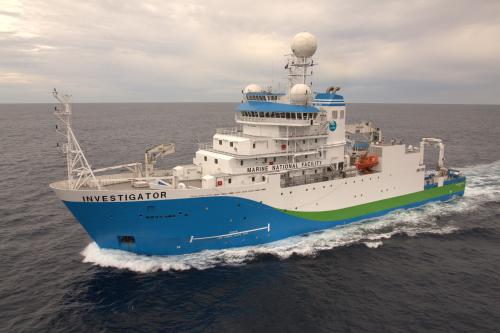
The vessel was designed by RALion and the principal particulars are as follows:
Length 93.9 m
Beam 18.5 m
Depth 9.45 m
Draft 6.2 m
Gross tonnage 6082
Crew 20
Science personnel 40
Main Engines 2×diesel-electric
Propulsion motors 2×L3 AC reversible
each 2600 kW
Propellers 2×Wartsila 3.5 m diameter 5-blade fixed pitch
Generators 3×9 cyl MaK diesels
each 3000 kW coupled to 690 kV AC generators
Bow thruster Electric azimuthing retractable 1200 kW
Rudders 2×independently-vectoring Becker high-lift
Dynamic positioning Kongsberg K-Pos DP1
Cruising speed 11 kn
Range 10 000 n miles
Endurance 60 days
Classification Lloyd’s Register
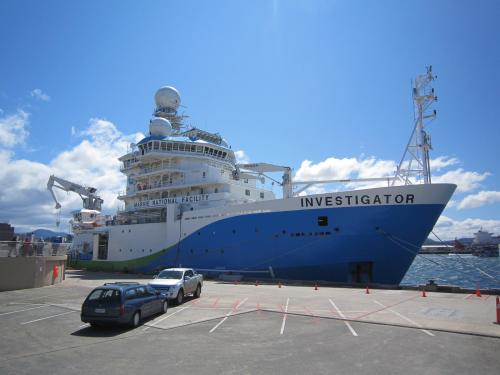
Investigator berthed at the Marine National Facility in Hobart
(Photo Phil Helmore)
Here Marcus showed the general arrangement drawings, including isometric views, of the vessel. Some of the interesting points were the a-frame at the aft end for deployment of trawling and towed sampling gear, the foremast which contains a sampling point for clean air, space just aft of the superstructure for placement of four 20 ft containers (in two tiers of two) for specialist equipment and labs. The on-board laboratories are on the main deck, starting at the aft end of the superstructure and become cleaner moving forward. The galley, mess and scientists’ cabins are on the focsle-deck level (i.e. one above the main deck), and the crew, hospital, offices and conference room are accommodated on the deck above that, with space for two more 20 ft containers forward of the superstructure.
The Build Process
Bringing it all together started with the tendering processes to find
a suitable design;
a suitable builder; and
a suitable project builder.
The contract for design was awarded to RALion, a naval architecture and marine engineering partnership of Robert Allan of Vancouver and Alion Science and Technology Corporation of McLean, Virginia. The contract for construction was awarded to Sembawang Shipyard in Singapore in partnership with TeeKay Shipping Australia as the Prime Contractor and Project Manager. The design used the Woods hole Oceanographic Institute’s vessel Atlantis as a springboard, but you have to look closely to see the resemblance because of the modifications made to accommodate the requirements and the “wish list”!
Here Marcus showed a time-lapse video of the build and launch process, including cutting the first steel, fabrication, moving modules onto the building berth, engines being lifted aboard, superstructure module being lifted on, bow module being lifted on, the launching, and then views of the cabins, galley, laboratories, and the lounge.
The Finished Product
RV Investigator arrived in Hobart where she was fitted with her computing brain-power, did sea trials, and was then handed over to the Marine National Facility on behalf of CSIRO. The MNF was established in 1984, and takes applications for sea-time on the vessel, scrutinises them for scientific merit, and assesses the importance of the proposed research to Australia and the world, and then allocates time on board Investigator in accordance with the resulting priorities. Usual applicants include commercial entities, the Australian Government, CSIRO, etc, although anyone can apply. You could apply with your mates for a weekend fishing trip, for example, but would be unlikely to meet the scientific criteria. Similarly, of BP or Shell wanted to charter Investigator to drill in the middle of Sydney Harbour, the question “Why?” would have to have a very good answer, as would the question “Is this a good decision?”
Unfortunately, Investigator is limited to 180 days at sea per year due to Government financial policy decisions. The vessel could be used much more efficiently. This is highly political. A private company could charter the vessel for a full charter rate, but this happens very rarely.
The vessel is ice-strengthened; i.e. she can go to the edge of the ice in Antarctica, but she is not an ice-breaker.
The gondola and the drop keels are a challenge when docking, and she needs 3.6 m keel-block height. Previous dockings have been carried out in Singapore, but the Captain Cook Dock at Thales Australia in Sydney can accommodate her on the double-height blocks.
Here they showed a video of applying for sea time on Investigator.
Is she right for the job? Fundamentally, time will tell but, so far, she has been an excellent performer. However, there have been some huccoughs. She is a bespoke vessel, and some things are not in the best places. Sembawang is a repair yard, rather than a newbuilding yard, and they learned a lot on the way. If they were to build Investigator 2 now, then some things would be slightly different, but we are expecting a 40-year life for Investigator, so that is unlikely. There have been some issues, with the generators and shore power for example, but these will have various remedies, some ongoing.
Here they showed a video of the latest 60-day voyage to Heard Island.
Conclusion
The design and construction of RV Investigator has taken considerable time, but has delivered a vessel which is larger and much more capable than her predecessor, Southern Surveyor [or her predecessor, Franklin, or her predecessor, Kapala, or her predecessor, the tiny 11 m Marelda skippered by Ron Greig, for those who can remember her fishing off the NSW coast in the 1950s and 60s! — Ed].
Questions
Question time was lengthy and elicited some further interesting points.
The final cost of the vessel was of the order of USD 150 million, and the build-to-delivery time was a bit over a year. Steel was first cut in January 2012, with the keel laid on 9 May 2012. Investigator was transferred from Sembawang Shipyard to the delivery crew on 5 August 2014 for pre-departure testing and setup. The vessel arrived at its home port of Hobart on 9 September 2014 and was officially commissioned on 12 December 2014.
The three generator sets are resiliently mounted on rafts, and the rafts themselves are resiliently mounted.
The vessel is fitted with bilge keels and an active flume-tank stabilising system, i.e. the flume tank is pumped from side to side, rather than being passive.
The gensets are powered by 9-cylinder MAK engines, and the propulsion motors are powered by locomotive engines.
Some machinery has operational or functional limits in high sea states. The scientists know that they have limited time on board and, in order to get as much information as possible, they are keen to work—irrespective of the weather or sea state!
The vessel would have been ideal for the search for the missing flight MH370. However, she was delivered too late to be considered for the search, and then had a committed research program, so other vessels were tasked with the job, including Fugro Discovery and Fugro Equator and, more recently, this year they were joined by Chinese vessels Nan Hai Jiu 102 and Dong Hai Jiu 101.
Greg Hellessey pointed out that the CSIRO website has a fly-through video of the vessel, and there is plenty of publicly-available data from research voyages on the website, now amounting to at least 40 000 lines of data. How does he know? His daughter has just come ashore from a voyage on board Investigator!
[The MNF website at www.mnf.csiro.au contains all the videos shown during the presentation, including the time-lapse video of the build and launch process, and the fly-through video of the vessel, and are all well worth watching—Ed.]
The vote of thanks was proposed, and the certificates and “thank you” bottles of wine presented, by Graham Taylor. The vote was carried with acclamation.
Reference
Kloser, R., Martin, T. and Sherlock, M. (2014), Characterising the Acoustic Footprint of Australia’s New Research Vessel, Investigator, Proceedings Inter-Noise Conference, Melbourne, 16–19 November.
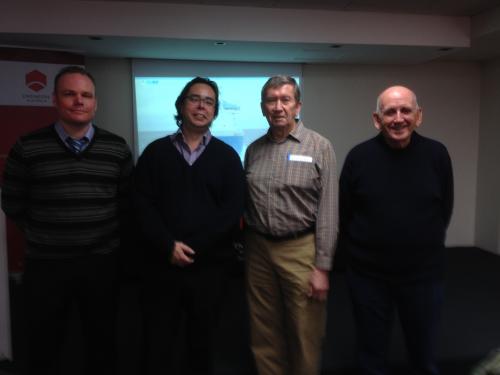
Marcus Ekholm (L), Tim Asome, Graham Taylor and Alan Taylor (Chair)