Little is known of how scale effects and laboratory effects influence the hydrodynamic modelling of oscillating-water-column wave-energy converters. The laboratory effects have been investigated at the Australian Maritime College by testing a scale model in the Test Basin.
Experiments were then conducted in the Coastal Wave Basin at the Queen’s University Belfast, Portaferry, Ireland, a state-of-the-art hydrodynamic wave-basin laboratory. The purposes of the experiments in the Coastal Wave Basin were to confirm the laboratory effects by way of reproducing the experiments previously conducted at the Australian Maritime College, and to test the scale effects inherent in physical modelling by testing two different scales of the same model.
The key parameters of interest of the experiments were the performance of the wave-energy converter in terms of the amount of energy absorbed from the incident waves under normal operating conditions, and the global loads imposed on the model under survival or extreme-wave conditions. These parameters (power and loads) are the two most important parameters to investigate in these wave basin experiments, as converters operating in the ocean have not only to produce power but also to survive the extremely-high-energy sea-states in storms.
This presentation focussed on wave-energy converters and the results of experiments conducted to determine the scale and laboratory effects. The final results are expected to aid in developing guidelines for hydrodynamic model test experiments of wave-energy converters.
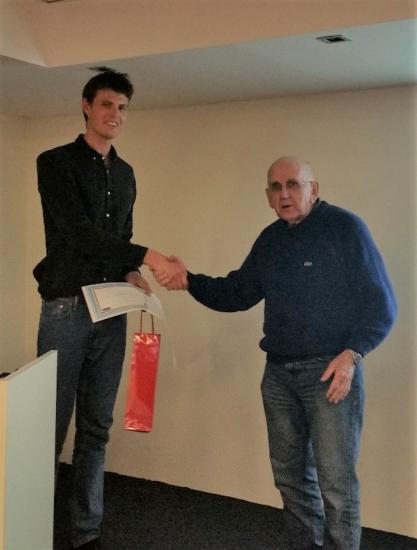
Jarrah Orphin (L) accepting his certificate and “thank you” bottle of wine from Alan Taylor
(Photo courtesy Adrian Broadbent).
The vote of thanks was proposed, and the certificate and “thank you” bottle of wine presented, by Alan Taylor.
[This presentation was recorded and is expected to be available as a webcast in the near future—Ed.]