Unexploded ordnance (UXO) – including undetonated artillery shells, grenades, landmines and other munitions – isn't just a problem for deepwater offshore sites. When UXO is present in the surf zone, it poses a major risk to human life and safety. Wave action, the corrosive effects of seawater and disturbances caused by swimmers and surfers can all disrupt and move UXO, increasing the likelihood of accidental detonation, resulting in serious burns and shrapnel wounds for anyone caught within several metres of the blast.
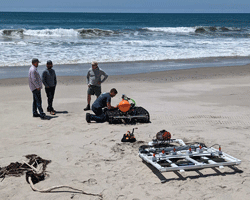
UXO detection in the surf zone also incorporates these risks – and, combined with poor visibility in this environment, makes drone technology an ideal solution for the task. Recently, US robotics specialist Greensea Systems had the chance to find out for itself, using its Bayonet 250 ‘crawler’ – or autonomous underwater ground vehicle – to conduct a surf zone UXO survey at an undisclosed location.
The AUGV was put to work over a period of eight days, covering 18km2, and operating in depths up to 3m and in wave heights of 1.2-1.8m. The vehicle was fitted with a towed sled equipped with White River Technology's (WRT’s) marine APEX technology, integrated into Greensea’s own OPENSEA software platform. “The rapid integration of the sensor sled facilitated the detection and classification of objects, with a buried depth of up to 3 meters based on material composition,” Greensea explains. During the trial, the crawler detected “several buried targets based on burial depth and signal signature”, Greensea confirms, though the company declined to go into further detail.
Launched last year, the Bayonet 250 measures 1.2m x 1.3m and has the deck capacity for 113kg (see Ship & Boat International July/August 2022, page 42). Each Bayonet 250 can operate with approximately 190mm of ground clearance, and is powered by twin 2kWh Li-ion batteries. With regards to vehicle range, Greensea says: “Moving at 0.5m per second, the vehicle can run a pattern to cover 6nm."