Ship & Boat International eNews: September/October 2022
The Microtransat Challenge has been stimulating innovation in autonomous boat design since 2005, and in 2022 it will receive an injection of youth via start-up enterprise Oshen Sail: a team of Imperial College London graduates backed by industry professionals, writes Hollie Lewis. The group aims to launch a fully autonomous sailboat to cross the Atlantic, setting off from Portugal in October 2022 and landing in the Caribbean by January 2023, and to become the first contestants to complete the Microtransat Challenge in its history.
Oshen’s team – founded by Anahita Lavarack (boat and control system design), Ciaran Dowds (software design) and Kate Pesenti (marketing, sales and finance) – credits multi-disciplinary expertise for the success of the design, and is enthusiastic that a unique path-planning algorithm will guide its autonomous creation across the line. Sponsorship from Unique Group, partnerships with Inmarsat and CLS, and industry support from Rolls-Royce and Constant Fibreglass have been invaluable to Oshen’s transatlantic attempt.
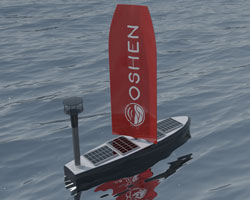
The Microtransat race rules state that the hull overall length is restricted to 2.4m and that no communication can be sent to the boat during transit. The Oshen entry has a length of 1.25m and a sail height of 1m, and is powered principally by wind and solar power. Being unable to afford a mould for the prototype, the team used the university’s 3D printer to make a prototype from 3mm-thin ABS plastic sections, wrapped in fibreglass for strength.
Following the transatlantic crossing, Oshen plans to use the USV to collect all of the ocean data (such as water temperature, air pressure and wave/current profiles) that a typical drifting buoy would collect. There are thousands of drifting buoys in the ocean; however, these packages must be dropped off in the location of interest and have a tendency to drift away from the location of interest within a short space of time, making the process inefficient and costly. Drifting buoys are also left to pollute the ocean at the end of their lifecycle as it is not cost-efficient to retrieve them. Oshen hopes to improve this process with the ability to sail the unmanned vessel to the location of interest and remain in position for as long as required, before returning to shore once it has achieved its mission.
The path-planning algorithm is responsible for selecting a safe and suitable path for autonomous surface vessels. Oshen plans to patent its path-planning technology and, as such, was unable to give too much away; however, the team did explain that the algorithm takes wind and current models – NAVGEM and HYCOM, to be precise – in combination with information on the boat’s dynamics to compute a cost grid for the area. Oshen plans to install an AIS receiver on the boat to divert its path away from nearby vessels, but concedes that, due to the boat’s low speed, a collision avoidance system is likely to be redundant. The challenge experienced by previous Microtransat challengers is being picked out of the water by fishing vessels. Ideally, Oshen’s boat will be able to navigate away from sight of other vessels.
As required by Microtransat rules, no communication can be sent to the boat for the duration of the crossing, but the boat can send information back to the team. The Iridium satellite system is used as the primary system for transmission, with a back-up Argos modem for position transmission. The team has assembled an online database to store and display all position information and sensor readings to allow any interested parties to track the boat’s hourly progress from Oshen’s website.
Oshen’s vessel is designed to withstand Force 8 on the Beaufort scale (up to 40knot wind speed) and has been tested to Force 6 (up to 27knot wind speed) in the Irish Sea, helping the team narrow down the final design. A typical voyage across the Atlantic for a yacht can take three to four weeks; however, Oshen’s sailboat will be exposed to the elements for approximately three months, making testing in a variety of conditions crucial to a successful outcome.
Anahita Laverack, Oshen co-founder and aeronautical engineering graduate from Imperial College London, comments: “Mankind has travelled to the Moon, we have robots on Mars, and yet no one has managed to cross the Atlantic fully autonomously. It demonstrates how difficult this challenge is, but also inspires us to be the one to solve it.”
(For the full article, see Ship & Boat International September/October 2022)