Ship & Boat International eNews: September/October 2022
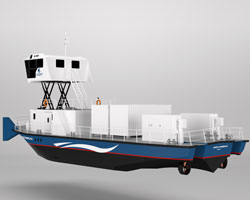
Lithuanian naval architect Western Baltic Engineering (WBE) has unveiled the design for what it says will be the first ever electric pusher for non-propeller barges deployed on Europe's inland waterways. The vessel, dubbed the ‘Electric Eel’, will be constructed in 2023 at WBE’s sister group, Western Shipyard, and will be operated by the Lithuanian Inland Waterways Authority.
The authority estimates that the pusher could remove 10,000 trucks annually from Lithuania’s roads. Eglė Mikalauskienė, WBE’s head of sales and marketing and a trained mechanical engineer, adds that road freight accounts for 75% of all freight in the EU overall, compared to just 6% for zero-emission vessels on inland waterways transport (IWT) routes. “There is massive political pressure to green up the IWT network,” she comments. “There is a fleet of 332 diesel pushers on the Danube alone, pushing more than 2,000 non-propelled barges. We estimate each of these vessels is emitting 196,317kg tank to wheel (TTW) of CO2 per navigation.”
The 27.4m x 9.2m boat will draw 1.2m and carry three crew members. Power will be sourced from three battery packs: two stored in swappable TEU containers on deck, which can be replaced by crane when the vessel is in harbour; and one installed permanently below deck, which can be charged at quayside. All three will generate 7,548kWh of energy combined. “The battery supplier will be revealed following talks at a later stage,” Mikalauskienė says. However, she confirms that the three batteries will have a combined weight of 74tonnes.
The internal battery pack should take around nine to 10 hours to charge at the end of each one-way trip. WBE anticipates a range of 250km between charges, a pushing capacity of 2,000tonnes and a top speed of just under 12knots when travelling downstream, and 5.4knots upstream, at 85% engine load.
Adding batteries to small-ship operations may slash fuel consumption and emissions, but it spells extra weight and draught for the vessel – which, Mikalauskienė says, proved to be WBE’s “biggest challenge", especially as water levels within the EU’s 41,000km IWT network are low, exacerbated by this summer’s heatwave. “We had to design a vessel that was no more than 195dwt, with a draught not greater than 1.2m,” she explains. “We created a super-efficient hull design which will operate brilliantly on shallow waters in Europe and around the world. Through trial and error, using rigorous CFD testing, we have produced the smoothest possible hull resistance.”
WBE also specified thinner, lighter steel for the vessel, guided by class society Bureau Veritas, to ensure that the material remained strong enough for safe operations. As a bonus green feature, the pusher will use a wind turbine, rated approximately 5kW, to capture energy for the boat’s lighting, galley and crew facilities, sparing the three batteries from additional drain.