Spanning more than 3,800km in length, the Brahmaputra is one of Asia’s major rivers, running through Tibet, India and Bangladesh and often undergoing significant fluctuations in current. Unfortunately, the river has seen its fair share of boat accidents over the years. Perhaps most memorable was the capsizal of an overcrowded ferry in Assam, India in 2012 – an incident that claimed the lives of at least 103 persons. As recently as September 2021, two passenger vessels collided on the Brahmaputra while the river was swollen during monsoon season, causing one fatality and depositing dozens of passengers into the water.
As such, the Brahmaputra caught the attention of the Worldwide Ferry Safety Association (WFSA), which selected the river for its ninth Annual International Student Design Competition for a Safe, Affordable Ferry. The contest called for a ferry capable of carrying 150 passengers and eight vehicles, plus motorbikes, bicycles and freight. In total, 12 international student teams submitted ferry designs, and first prize was awarded to Team Nawasena ITS, drawn from the Department of Marine Engineering at Indonesia’s prestigious Institut Teknologi Sepuluh Nopember (ITS).
Nawasena ITS was founded in 2017 “to focus on research and development of an affordable, safe, efficient and environmentally friendly ship design for the future”, explains Anak Agung Madya Kusuma Dewa, part of the team’s 3D modelling and visualisation division. He tells Ship & Boat International: “Our team has taken part in several ship design competitions, in Indonesia and internationally.” Domestic wins have included prototype patrol boat and autonomous submarine designs for Indonesia’s naval-oriented KKCTBN contest, and the team has also participated in the Cruise Lines International Association (CLIA) Life Saving Appliance Innovation competition. And, of course, Nawasena ITS achieved second place in the previous WFSA ferry design contests, highlighting the team’s strong pedigree in ship design.
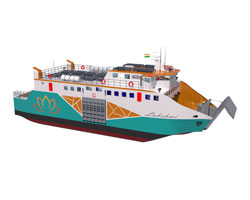
For this year’s WFSA contest, the team developed the concept for the aluminium ferry Lakshmi, named after the Hindu goddess of wealth and good fortune. A monohull was selected to anticipate the risk of the vessel running aground or losing stability – a crucial consideration when operating on a river prone to shifting sandbanks. As well as meeting the 150-pax capacity specified by the WFSA, Lakshmi can carry eight four-wheel vehicles, 44 motorcycles and 10 bicycles on its vehicle deck, which features a ceiling height of 1.5m. This deck is fitted with both side and bow ramps, to permit multiple berthing procedures.
All cargo space is located on the vehicle deck. The port side offers approximately 38.7m2 of cargo space and houses an 11.6m2 chiller and a 12.6m2 freezer. The starboard side, meanwhile, provides around 43.4m2 of cargo space and features an emergency generator room and a bicycle rack.
Aware that COVID-19 hasn’t gone away, the team has positioned a disinfection chamber at the entrance to the passenger deck, while partitions between the seats limit direct contact with other passengers. A HEPA filter would also be applied to the cabin air duct. Additionally, a shower room, aft, could be converted into an isolation room for passengers exhibiting coronavirus-related symptoms.
Lakshmi would run on a diesel-electric powertrain, using biodiesel as the fuel, and would also draw on 12 batteries to power onboard equipment. The batteries can be charged by the onboard generators, or by 24 solar panels arranged across the open aft space of the navigation deck (66m2) and the wheelhouse roof (39m2). The set-up would grant the ship a service speed of 15knots.
Mindful of previous accidents on the river, the team has added a pan-tilt camera to Lakshmi’s inventory, to help the crew to avoid rocks, floating logs and other ferries. The camera would also track the speed and acceleration of any approaching vessel. And, to tackle the perennial problem of passenger overcrowding, Lakshmi would be fitted with an automatic passenger count sensor and image recognition camera. “This would send a warning to the navigation deck or to the port whenever overcrowding occurs,” says Dewa. Simultaneously, sensors applied to Lakshmi’s waterline mark would detect overloading of cargo and vehicles.
(For the full in-depth article and technical particulars, check out Ship & Boat International September/October 2022)