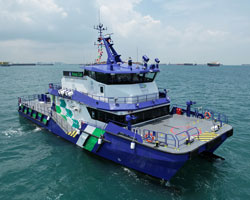
Developed jointly by naval architecture firm BMT and Singaporean newbuild factory Penguin Shipyard International, the 34.5m patrol boat MPA Guardian has its pick of three propulsive modes, enabling its crew to balance speed and reliability with minimised environmental impact. The aluminium-built, hybrid-powered catamaran was commissioned by the Maritime and Port Authority of Singapore (MPA), which will use the boat to support patrol and search and rescue (SAR) missions, oil spill clean-ups and salvage operations in its waters. It is expected that Singapore’s government will also utilise MPA Guardian as a floating test bed for new technologies, and as a launchpad for marine and aerial drones.
The boat can accommodate up to 24 persons, with 12 crew bunks located aft of the wheelhouse on the upper deck. The bunks are arranged as ‘accommodation capsules’, custom-designed by Penguin. MPA Guardian can also bring aboard 24 survivors, and hosts a dedicated first aid room. Additionally, the crew mess area can repurposed to accommodate casualties on stretchers.
Martin Bissuel, BMT business sector lead for specialised ship design, tells Ship & Boat International: “The design was carefully developed to maximise working space and efficient workflow across all areas of the vessel." The 55m2 aft deck is the designated cargo deck, with a loading capacity of 1.1tonnes per m2, and is laid out to accommodate two 10’ containers and four 1m3-capacity totes. The aft also features a 7m fast rescue RIB, complete with a customised launch and recovery ramp jointly developed by BMT and Penguin. The upper aft deck will be used for the testing of drones and other emerging technologies.
The foredeck covers 60m2 and is arranged to permit MPA Guardian’s crew to safely board larger vessels, such as container ships. This deck is also equipped with a Jason’s Cradle man overboard (MOB) casualty recovery device, and is designed to provide “uninterrupted arc for the two firefighting monitors at the bow”, Bissuel says Each of these monitors, supplied by FFS, is capable of 110m throw, with a flow rate of 600m3 per hour. The firefighting pump takes its water directly from the sea, so there has been no need to install a dedicated water tank. Bissuel explains: “The firefighting foam can be carried in totes on the aft deck, so this modular design means that the vessel only needs to carry the foam when required.” MPA Guardian also features deployable arms to spray oil spill dispersant fluids on each side of the vessel.
The amidships rescue platform is equipped with MOB recovery cranes mounted directly above. “MPA Guardian will also be used as the command vessel in multi-vessel operations,” says Bissuel, “so the main lounge has moveable seating which can be rearranged into a boardroom/control centre layout around a central console.”
As mentioned, the boat’s hybrid propulsion will enable it to operate in three distinct modes, covering a range of operational applications. The propulsive set-up comprises twin MTU 16v 2000M96 diesel engines, rated 1,790kW apiece, with 370kW in-line Praxis motors (of the make EMG-590), connected to the gearbox PTI/PTO. Praxis also supplied MPA Guardian’s batteries, comprising twin 240kWh battery packs – one in each hull.
The first mode, ‘sprint mode’, would see the boat engage both MTU engines, enabling a service speed of 25knots and a top speed of 27knots. The diesel engines would simultaneously act as ‘generators’ by charging the batteries, a process that should take two hours, BMT estimates. Secondly, in ‘single-engine mode’, the patrol boat would drive one prop with one MTU diesel and the other prop with one Praxis electric motor, for a service speed of 10knots. Finally, ‘full-electric mode’ is pretty self-explanatory, with both diesels switched off and the electric motors running the show. In this latter mode, MPA Guardian would cruise silently and emissions-free for approximately three hours.
However, Bissuel says, the differing propulsive modes should not be viewed as ‘either/or’ options. “MPA Guardian is designed for three-day missions, with varying time spent in all three operational modes,” he says. In the long term, he predicts that MPA Guardian could save around 4,000litres of fuel on a “typical three-day mission” compared to a diesel-powered patrol boat of the same displacement.