The past few years have seen an upsurge in the production of vessels designed to remove floating debris and trash from coastal and inshore waters: not only cleaning up the immediate environment but preventing outflow of this waste into the sea, where effective removal becomes far more difficult.
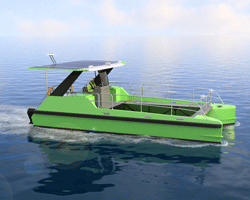
The new Grasshop catamaran concept, developed by Thailand-based boat design studio Albatross Marine Design (AMD), aims to join this growing band of specialist clean-up vessels. The boat was initially developed in response to a request from an AMD customer situated in the UAE, but could also find plentiful applications throughout Southeast Asia. For example, four high-priority areas in Thailand are responsible for the discharge of about 9,300tonnes of plastic waste into the marine environment each year, the World Bank Group reported in 2022.
Intended for operations in close proximity to beaches, marinas/ports and embankments, the 10m x 4.5m Grasshop has a suitably shallow draught of 240mm. Albert Nazarov (FRINA), AMD managing director, tells Ship & Boat International that the vessel will be able to safely operate out to “five miles from harbour”, while its flat bottom makes it easy to beach the boat.
The Grasshop is 100% electric, so extended garbage collection missions won’t be offset by the harmful effects of diesel emissions. The boat’s roof hosts a 13.5m2 spread of solar panels, drawing up to 3.4kW of clean energy with which to feed its batteries.“We plan to use electric outboard motors,” Nazarov confirms, suggesting that Torqeedo’s Cruise e-motor range (which spans outputs from 6-25hp) could be one option. Onboard recharging would most likely take place overnight, utilising a shore-based power source, and this all-electric arrangement will gift the Grasshop an operational speed of around 4knots, increasing to 6knots max.
The Grasshop's modular design enables end users to disassemble the boat, to ship to other locations. The basic version will be built in composite materials, though aluminium alloy can be specified. The Grasshop has a depth of 1.2m, while the accommodation area – arranged for a two-person crew – offers 2.2m of headroom. “The hulls accommodate the battery compartments, one toilet and a small storage/hanging locker,” says Nazarov. The Grasshop’s control station is located on the deck, for minimal obstruction to the crew’s line of sight.
Floating trash is collected by a removable basket, positioned between the boat’s hulls, which can realistically collect up to 5m3 of debris, Nazarov says.
Additionally, AMD is now offering a ‘strength calculation’ service for ships built from composite materials, using its in-house-developed SigmaLAM software solution. SigmaLAM analyses planned composite newbuilds against ISO 12215-5 strength criteria or the parameters specified by class societies. Customers can request calculations for monohulls and multi-hulls that incorporate complex laminates, high-tech fibres and sandwich structures into their designs, to gain an overview of factors such as weight efficiency, safety and compliance with regional regulations.
The resultant strength reports, including structural diagrams, can be generated in MS Excel. So far, the software has been certified by Russian Maritime Register of Shipping (RS), and AMD expects to develop tailored versions for the Indian Register of Shipping (IRClass) and UAE-based class society Tasneef Maritime in due course. The service will mainly cater to patrol and rescue boats, fishing boats, recreational craft and yachts, though could also be used to assess composite-built minehunters and USVs, AMD says. Nazarov estimates that use of composite materials in the South-East Asian marine sector alone is currently growing by 7.8% per year.