Bing Zheng began his presentation by asking What? Why? and How? i.e, What are we trying to achieve? Why are we doing this? and How are we going to do it? He then proceeded to give some insights.
What?
What we are trying to achieve is a method for analysing compositemetal bonded joints in ships. Bing Zheng’s final-year thesis project has involved testing the strength of several different types of compositemetal bonded joints to failure. This determines the maximum load which can be borne by a particular type of joint.
The eventual aim (not achievable in this thesis alone) is to simplify the results into a decision matrix which can then be easily used by naval architects and shipyards to decide on the best type of joint for a particular application in a particular location.
Why?
Composites have a number of advantages. A quick search of the internet will throw up 101 advantages, including the following:
Light weight: Composites are light in weight, compared to most woods and metals. Their lightness is important in ships, for example, where less weight means better fuel economy or more cargo, and less top-weight means better stability characteristics.
High strength: Composites can be designed to be far stronger than aluminium or steel. Metals are equally strong in all directions. But composites can be engineered and designed to be strong in a specific direction.
Strength/weight ratio: Composite materials can be designed to be both strong and light, and have a higher strength/weight ration than either of the other two common shipbuilding materials, steel and aluminium.
Corrosion resistance: Composites resist damage from the weather and from electrolytic action which can eat away at steel and aluminium.
High impact strength: Composites can be made to absorb impacts¯the sudden force of a bullet, for instance, or the blast from an explosion.
Design flexibility: Composites can be moulded into complicated shapes more easily than most other materials. This gives designers the freedom to create almost any shape or form.
Dimensional stability: Composites retain their shape and size when they are hot or cool, wet or dry.
Non-conductive: Composites are nonconductive, meaning they do not conduct electricity.
Non-magnetic: Composites contain no metals; therefore, they are not magnetic.
Radar transparent: Radar signals pass right through composites, a property that makes composites ideal materials for military use.
Low thermal conductivity: Composites are good insulators¯they do not easily conduct heat or cold.
Durable: Structures made of composites have a long life and need little maintenance. We do not know how long composites last, because we have not come to the end of the life of many original composites. Many composites have been in service for half a century.
However, it is not all beer and skittles! Composites are combustible, and require alternative arrangements for structural fire protection. Here Bing Zheng showed a slide of a fire on board a vessel, with all of the superstructure alight. Small vessels may be built entirely of composites¯just check all the recreational motor boats and yachts! However, larger vessels are restricted by the rules of classification societies or of the International Maritime Organisation (IMO).
For a long time, the prescriptive rules for safety at sea in IMO’s SOLAS Chapter II-2 excluded other construction material than “steel or equivalent material”, which meant that aluminium or composite materials could not be used in superstructures, structural bulkheads, decks and deckhouses. However, since 2002, a new Regulation 17 in Chapter II-2 allows construction of material other than steel, provided that the material can give the same safety level as the ship would have had if it had been constructed according to the prescriptive rules for steel ships. This led to more vessels being constructed with composite superstructure and steel hull, thus reaping the benefits of the composite materials while staying within the regulations.
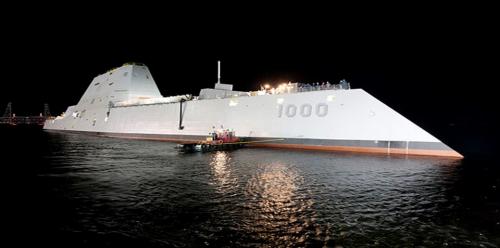
An example given was USS Zumwalt (DDG-1000), a guided-missile destroyer of the United States Navy. She is the lead ship of the Zumwalt class and the first ship to be named for Admiral Elmo Zumwalt. Zumwalt has a steel hull and composite superstructure (balsa-cored carbon fibre using vacuum-assisted resin-transfer moulding), with a bonded joint. She has stealth capabilities due to her tumble-home topsides and composite superstructure, and has the radar cross-section of a fishing boat despite her large size¯length 182.9 m, beam 24.6 m, draft 8.4 m and displacement 14779 t.
To proceed further, bonded joints were chosen due to their numerous advantages. They prevent corrosion¯bolted joints in steel are subject to rusting and electrolysis, for example. They can be designed to reduce stress concentrations and, hence, to reduce weight.
USS Zumwalt
(Photo from Wikipedia website)
How?
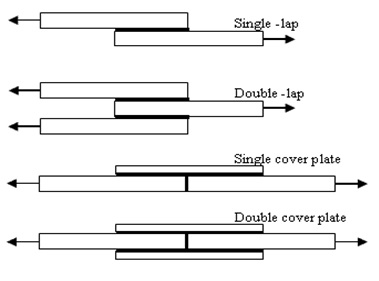
This project is the inauguration of an ongoing program at UNSW Australia to develop the analysis matrix. Here we manufactured and tested four different types of bonded joints with two different types of adhesive, epoxy and vinylester.
Types of joints tested
(Drawing courtesy Bing Zheng Ho)
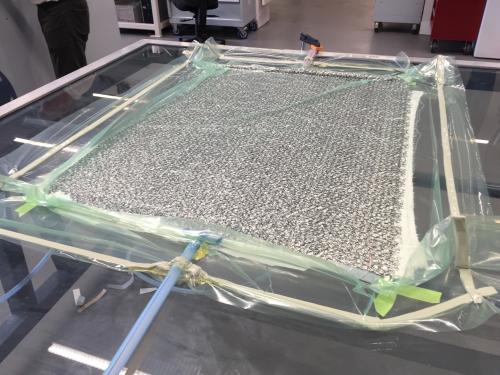
The joints were laid up and vacuum resin infused on the layup table in the laboratory at UNSW Australia.
Layup on table ready for infusion
(Photo courtesy Bing Zheng Ho)
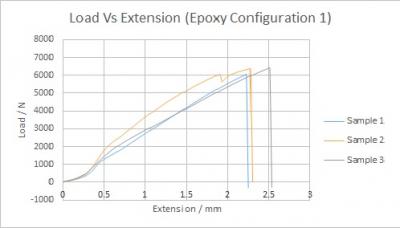
The joints were then tested to failure in the 50 kN Instron testing machine, using three tests for each type of joint. A typical set of results is shown in the graph for Configuration 1 using epoxy as the adhesive.
Results for three tests on Configuration 1 using epoxy adhesive
The results for epoxy Configurations 2 and 3 seem somewhat anomalous, and may need to be checked further. However, the results in general show that symmetrical joints perform better than unsymmetrical joints.
The project can easily be extended by investigating the effects of different types of surface preparation on the metal, different metals, the length of the overlap, the bondline, and various composite materials.
Conclusion
This project has made a survey of the need for, and advantages of, using composites in conjunction with metals in ships, and has made a start on analysing the strength of compositemetal bonded joints, and has come up with useful results.
Questions
Some further interesting points were elicited during question time.
The long-term durability of adhesives is not well-known. An example was given of composite sewer pipes which were fastened together with Araldite, but which had to be pulled up years later when the Araldite failed! Unfortunately, the condition of bonded joints cannot be checked as, for example, a bolted joint in steel or aluminium.
The configuration of the bonded joint in USS Zumwalt is not known, but it is expected that it would be a symmetrical joint with the composite superstructure bedding down in a U-shaped channel in the steel.
USS Zumwalt is not the only vessel with a steel hull and composite superstructure, as a search of the internet will show.
The vote of thanks was proposed, and the certificate and “thank you” bottle of wine presented, by Bing’s thesis supervisor, David Lyons.