Eric began his presentation by saying that there are different approaches to emissions reduction for two-stroke and four-stroke engines, and that this is a brief overview of a huge subject.
To put marine emissions into perspective, globally there was a total of about 100 000 ships of more than 100 GT in 2007. These ships carried 95% of inter-continental transport, and 71% of total global trade. However, they produced only 14% of the human-made NOx and only 3% of human-made CO2 emissions. On a g/t-km basis, this about one-fifth of the NOx and one-tenth of the CO2 emissions of cargo aircraft, for example.
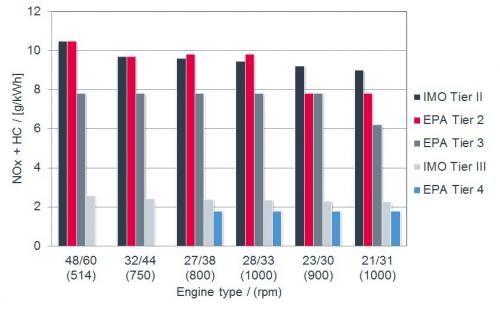
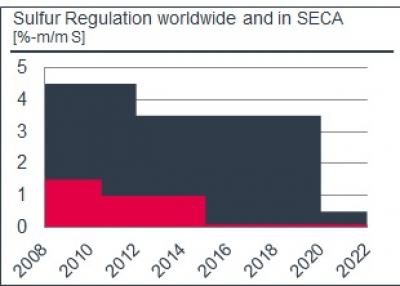
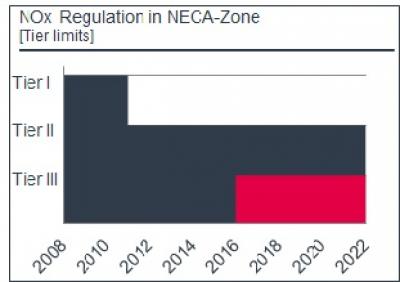
The IMO and various Environmental Protection Agencies now have regulations in place to limit the emissions from ships, with the regulations tightening about every five years. Marine engines are all now Tier II compliant, and engine manufacturers have been working hard on Tier III. At the first hint of regulations, engine manufacturers have to start work immediately, because it takes approximately five years (minimum) to design/re-design and produce a new engine.
NOx and HC IMO and EPA limits
(Image courtesy MAN)
SOX IMO and EPA limits
(Image courtesy MAN)
NOx IMO and EPA limits
(Image courtesy MAN)
Emissions
Among the impacts of the main emissions on the environment and human health can be listed the following:
Carbon dioxide (CO2) Global warming effect.
Sulphur oxides (SOx) Acidification of water and land, acid rain, inflammation of airways, sulphurous particles, sulphuric acid.
These all present challenges, but there are solutions, including:
Carbon dioxide (CO2) Common-rail technology, more-efficient power train, and gas as marine fuel.
Sulphur oxides (SOx) Low-sulphur fuel (MGO), de-sulphurisation (wet scrubber), and gas as marine fuel.
Nitrogen oxides (NOx) Catalysts (SCR), exhaust gas recirculation (EGR), and gas as marine fuel.
De-SOx Technologies
The control systems (engine and exhaust) are all integrated, and talk to each other. There are only one or two things that can be done for SOx. The next challenge will be running on low-sulphur fuel before entering harbour and, subsequently, when leaving harbour too. Low sulphur in the fuel means that there is less heat in the fuel, and they may have to start heating diesel fuel, which would be a real shock! Wet scrubbers are not used widely because they are costly, and because everything has to be removed and stored on the vessel for discharge ashore, as the products cannot go overboard.
Emission Control Areas
There are already emission-control areas in Europe (covering the North Sea and the Baltic) for SOx, and in North America (covering the east and west coasts of Canada and the USA) for both SOx and NOx. There is a lot of traffic in the European areas.
New owners look at the costs of the various technologies, and where they are going to operate the vessel. Some owners were caught because the keels of some vessels were to be laid before 31 December 2015, but were delayed, and now they need to fit emission-control gear.
One solution is to go to gas fuel immediately, and solve all problems, which is what some large two-stroke engines do. All marine MAN engines built now are Tier III compliant.
De-NOx Technologies
Selective catalytic reduction (SCR), LNG fuel, and exhaust gas recirculation (EGR) can all meet Tier III requirements. Fuel-water emulsion (FWE), humid air motors (HAM), and internal engine modifications (IEM) cannot meet the Tier III requirements (by varying margins) on their own.
Four-stroke Engines
SCR has been chosen as the primary Tier III solution for medium-speed engines. EGR is under development, and requires new engine technology. In fact, EGR does not yet work well on four-stroke engines, as there is insufficient gas flow. The exhaust gas is cleaned and put back into the engine, but it is hard to get rid of the Sulphur which must be stored on the vessel.
MAN engines are Tier II compliant by themselves, and are very different to the diesel engines of 20 years ago. MAN engines with an SCR unit in the exhaust line are Tier III compliant.
SCR Technology
SCR units use urea as the reduction agent. There is a number of advantages, including the fact that it is a proven and commercially-available technique (as has been verified extensively in the automotive industry), and has high NOx-reduction potential (up to 90%). Challenges for its use include the need for consumables (the urea-solution), and control of the exhaust gas temperature. Urea is produced worldwide, with a global production capability of approximately 70 Mt/a. It is widely available in Europe, the Mediterranean, the Middle East and Asia, and at limited ports in North and South America, non-Mediterranean Africa, and at Sydney and Brisbane in Australia. Storage of urea on board the vessel must be in stainless steel tanks.
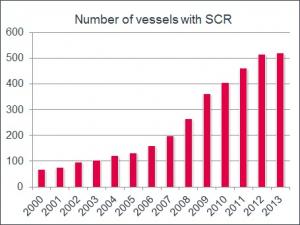
Because of its efficiency, there is a rising market for SCR. It is expected that emissions will come more and more in the public interest and that further Nitrogen-ECAs will be adopted in the future due to public attention. SCR is therefore expected to become a standard for shipping.
Numbers of vessels with SCR
(Image courtesy MAN)
An interesting feature is that IMO is requiring one responsible party for compliance of the engine-plus-SCR-system, and the responsible party will be known as “The Applicant”. MAN is licensed to install engines in ships, but must also prove that the whole system is compliant and will continue to be so. A third party comes in and tests the system to prove compliance, and so MAN becomes The Applicant.
MAN’s SCR Approach
In Augsburg, Germany, MAN has a gas test bed. In order to test SCR systems, they built a full-scale SCR unit for use on an 18-cylinder, 48/60 engine producing 20 MW. This system has been on test since 2012 and now has 10 000 h of operation on SCR. The same engine and gensets were installed on the vessel Petunia Seaways in 2012, and the vessel is now Tier III compliant.
As engines get larger for more power, the SCR kits become larger and more numerous. MAN has kits for engines from 430 kW up to 22 MW.
The scope of supply for an SCR kit includes the reactor, catalyst elements, soot blower, sensors, air reservoir vessel, mixing devices, dosing Unit, urea lance, urea pump, and safety control system.
Reduced operation temperature helps in saving fuel. A conventional SCR operates at 355oC at the turbocharger, because a high temperature is needed to clean the catalytic converter. However, MAN engines operate at 320oC at the turbocharger, with regular but infrequent bursts to 370oC for cleaning. The necessity for regeneration mode is detected by sensors, and the regeneration time varies depending on fuel quality.
MAN’s Design Support for Customers
MAN provides support for customers, from rough planning to detailed design. There is a Clean Funnel Configurator available online, which gives an over-all view or step-by-step view, provides CAD-files for pre-planning and auto-generated PDF-file of the summary. The next stage involves MAN’s SCR design tools for urea consumption, the pump module and the mixing device. Finally, there is the Project Guide (available online) for installation guidelines, system specification, and dimensions.
MAN provides all tools for efficient planning and gives full support in all project stages. MAN also ensures an efficient process for Tier III certification.
MAN has secured the world’s first IMO Tier III certification according to Scheme B approved by classification societies DNV GL and CCS, and certification to the other major classification societies is in progress.
Strengths of the Integrated Solution
Engine and SCR are set as a core competence at MAN. Intelligent exhaust gas temperature control optimises system efficiency. Up to 2.5 g/kWh of fuel oil consumption savings during SCR operation (compared to third party SCR supplier). Closed-loop control minimises urea consumption. All HFOs with up to 3.5% sulphur content can be accommodated. Modular kits of SCR components achieve minimum variety and cost. IMO Tier III certification responsibility rests with MAN.
Two-stroke Engines
For two-stroke engines, the same principles apply, but everything gets bigger! The problem is what do we do, and how do we control it?
The volume is a problem; i.e. to fit parts onto the engine. It is hard to fit the EGR and SCR too, because their volumes get bigger. Two-stroke engines need a longer stroke then four-stroke engines to burn the fuel efficiently¯four stroke engines are approximately square (with bore approximately equal to the stroke), but two-stroke engines are not.
We have seen where there are existing emission control areas (ECAs) and other countries are considering, e.g. Mexico, the west coast of Norway, the Mediterranean, Singapore and Japan. What we don’t know is when they will happen. Australia is really dragging the chain in in this area, as ECAs are not even being considered!
Historical data shows that 47% of ships entering the North American ECAs are MAN-powered. However, MAN power 83% of the large vessels due to licensing arrangements.
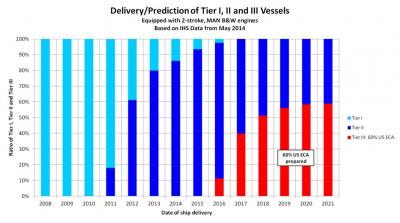
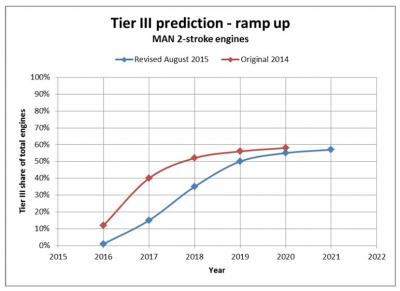
Here Eric showed a chart of forecast MAN low-speed engine deliveries for vessels of 2000 dwt or more, and a graph of the forecast Tier III engine take up.
Forecast MAN low-speed engine deliveries
(Chart courtesy MAN)
Forecast MAN Tier III engine take-up
(Graph courtesy MAN)
MAN has a strategy for each fuel. ME-C engines are mechanical/electronically controlled, and use MDO or HFO as fuel. ME-C-GI are high-pressure gas injection engines and use methane, ethane, etc., as fuel. ME-C-LGI are high-pressure LF fuel injection engines and use propane, methanol, etc., as fuel. All types are diesel engines with same platform and emissions can be controlled with respect to performance, efficiency, emissions, turbocharging and timing.
Standard Emissions Technologies
The two standard technologies to achieve Tier III requirements are selective catalytic reduction (SCR) and exhaust gas recirculation (EGR). EGR requires a new big-volume bit of kit on the side of the engine, where SCR is more condensed.
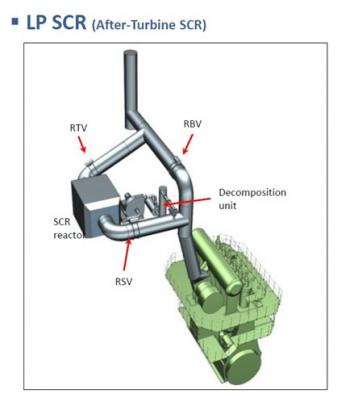
SCR can be either high pressure or low pressure, and each has a different layout.
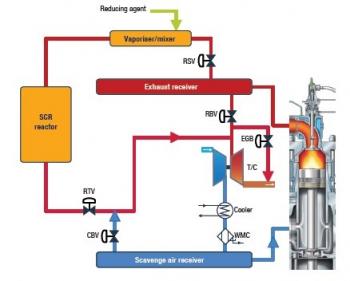
Here Eric showed slides illustrating the technology principles of SCR and EGR.
HP selective catalytic reduction technology principle
(Image courtesy MAN)
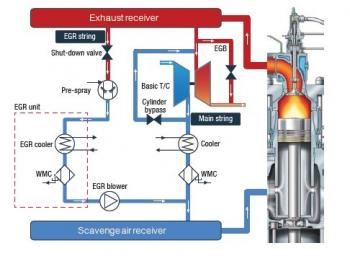
Exhaust gas recirculation technology principle
(Image courtesy MAN)
In EGR, the oxygen in the scavenge air is replaced with carbon dioxide, which has a higher heat capacity than oxygen, thus reducing the peak temperatures. Reduced oxygen content in the scavenge air also reduces the combustion speed, thus further reducing the peak temperatures. Decreased peak temperatures reduce the formation of NOx.
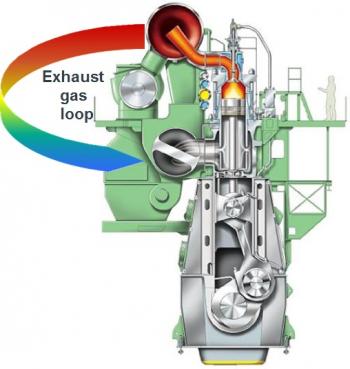
The exhaust gas recirculation loop
(Image courtesy MAN)
EGR configurations depend on cylinder bore. For bores of 3570 cm, EGR uses by-pass matching, while for bores of 8095 cm, EGR uses cut-out matching.
Pros and Cons of EGR and SCR
For fuel flexibility or low first cost/CAPEX, there is little to choose between EGR and SCR for two-stroke engines. If there is no sludge protection, you want the same technology for main engines and gensets, or you have to comply with no excess condensate being discharged overboard, then SCR is preferable. However, if you want a compact engine, want low operating cost or operate many hours in ECAs, or you are faced with possible new Tier III modes (for HFO design), then EGR is preferable.
More Information
If you would like more information, visit the MAN Diesel and Turbo website at www.mandieselturbo.com and click to find Marine Engines and Systems/Two Stroke/Project Guides/Other Guides/Emission Project Guide.
This guide also includes information on SOx scrubbers, combined EGR and SOx scrubber, SFOC penalties, all consumptions, installation issues, and compliance.
Installations in Service
MAN Diesel and Turbo has installations in service on board
Maersk vessel Maersk Cardiff. This installation is Tier III compliant, runs on HFO and is an integrated design; running with EGR primarily when there is an MDT crew on board. This is their primary EGR service experience platform, and now has 2000 h running. The EGR blowers have experienced no significant problems, but there are corrosion challenges and different materials are being tested.
Chevron vessels Polaris Voyager and Pegasus Voyager. These installations are Tier III compliant, were set up for HFO but run on MDO, and are integrated designs. MAN Diesel and Turbo is using Polaris Voyager as an EGR test platform for low-sulphur fuel, and Pegasus Voyager intends to run EGR.
Nisho Odyssey vessel Santa Vista. This installation is Tier III NOx compliant, has an engine-control system, uses a low-load method, and has an SCR control system and NOx sensors. Fields for improvement include valves, ammonia slip, maintenance of exhaust-gas boilers, integration of the SCR control system, and materials.
Conclusion
At present, we have achieved Tier III compliance for four-stroke marine diesel engines, and are working on two-stroke engines, principally on 240 000 t bulk carriers. There are issues with arrangements, because of the additional equipment required to be fitted into the engine room to achieve compliance. However, all engine manufacturers are doing the same things, and much of the technology comes from the automotive industry in cars and trucks; the equipment is just much bigger!
Questions
Question time was lengthy and elicited some further interesting points.
Efficiency in a two-stroke engine is improved with longer stroke. However, if there is a long throw on the crank, then the engine tends to move sideways. To counter this, the sideways thrust is taken by thrust pads in the crosshead.
The smallest marine engines are four-stroke, and the largest are two-stroke. Engine manufacturers need to be five years ahead of the game to get engines into production by the time requirements come into force.
With the engine builder in the role of The Applicant, thereby assuming responsibility for the EGR and SCR systems, what has this taken away from the Chief Engineer on board? It is the engine builder’s responsibility to say that the equipment can do the job, and to tell the Chief Engineer that the system is compliant if xxx happens.
There are complex control systems, and they are all automated, but the Chief Engineer needs to monitor and maintain them.
The Chief Engineer on one vessel with MAN crosshead engines had a history of failures of crosshead pins. The crosshead has highly-loaded bearings, and the pins are highly polished. The biggest issue is not the pins (these have increased in size over time to overcome the higher loading), but the lubricating oil technology. They are now working with clearances and water content in the lube oil, which must be cleaned correctly, or you get a crazy-paving effect on the pins. The problem is not mechanical, but in the lubrication technology and how they work together.
New technology currently goes back to the bearing manufacturers and how to achieve bonding of bearing material to the backing in bearings subjected to high loadings. The lube oil manufacturers need to keep can’t keep up with the bearing manufacturers and vice versa, so currently they have to use a larger wedge in the bearing to overcome the current lubrication issues. There is a need to avoid micro-seizures and crazy paving, so the usual solution is to constantly check/polish and to have temperature sensors on the crosshead pins.
The vote of thanks was proposed, and the certificate and “thank you” bottle of wine presented, by Bill Bixley.