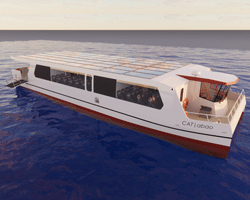
For the 10th instalment of its Annual International Student Design Competition for a Safe, Affordable Ferry, spanning 2022-2023, the Worldwide Ferry Safety Association (WFSA) shook things up by introducing a new stipulation for the participating teams. Up until now, the WFSA’s panel of judges had “always been neutral about the power source” of the student teams' proposed designs, Dr Roberta Weisbrod, WFSA executive director, announced last year. This time round, though, the entrants would have to develop an electric-fuelled ferry for the Pasig River in Manila, in line with efforts to decarbonise public transport across the capital. The vessel would have to be affordable to construct, acquire, operate, maintain and repair, and would boast capacity for 100 passengers.
The additional curveball of electric propulsion meant the teams would now have to consider the availability of shoreside chargers, battery-handling-related safety and the risk of loss of power. For example, the three stops on the proposed Pasig River route – Guadalupe, Circuit and Lawton – currently lack onshore charging infrastructure, though this is planned for the future.And then, there are the unique characteristics of the Pasig River toconsider: a tidal estuary with tidal variation of approximately 1.5m, prone to strong currents and rising water levels during the June-November monsoon season.
The WFSA contest attracted 16 entries from academic institutions across Asia, Europe and the Americas. The City University of Applied Sciences, Bremen was declared the winner with its CAT|abao concept: a 22m aluminium catamaran, deemed by the judges to be “solid in virtually all respects, with a great attention to detail”. Team captain Laurin Rösemeier tells Ship & Boat International. “The design of a fully electric ferry was exciting and challenging for all of us: we had to acquire a lot of knowledge at the beginning, especially in the field of battery and electric propulsion technology.” The team contacted electric drive company Baumüller and battery manufacturer Corvus Energy for more detailed info on the aspects of the powertrain design. “We realised early on that we would not achieve the service life we had aimed for with the battery power we had initially installed," he says. "Thus, in the advanced design phase, we suddenly needed much larger battery capacities, which brought with it many difficulties regarding our weight management.”
With the potential for passenger overcrowding in mind – sadly, still a problem in some developing countries, where operators are more likely to bend the rules to maximise ticket sales – the Bremen team designed the CAT|abao for a safe and stable working limit of 195 persons. To protect this complement, the ferry would carry a pair of 150-person liferafts, eight buoys and 217 lifejackets.
The Cat|abao concept is 100% electric, with no diesel back-up. The direct propulsion system includes: a pair of 235kW Baumüller electric motors; a six-pack of Corvus Dolphin NG batteries, rated a combined 754kWh; and twin fixed-pitch propellers. The power supply would be supplemented by a 130m2 spread of solar panels, rated 10kWh. Rösemeier says: “The charging station is to be housed at one of the landings, Circuit, and built using megawatt (MW) charging technology. The connection of the MW charging system and the access to the engine room are realised from the aft deck, with easy replaceability of the battery modules through the maintenance hatch cover.” He estimates that a time slot of approximately 10 minutes would be reserved for recharging during each journey.
“We recommend that you charge for 10 minutes after each trip to keep the depth of discharge [DoD] between 20-80% throughout the day,” says Rösemeier. “This will ensure a long battery life. Nevertheless, the ferry would be able to cover 61.5nm at a speed of 9knots with a 20% reserve, which means the boat can also be used for sightseeing or workshop trips.” Six such e-ferries, working in tandem, would guarantee a 20-minute schedule on this Pasig River route.
(For the full, in-depth article, plus the e-ferry's technical particulars, check out Ship & Boat International July/August 2023)